

Rook vs Jackdaw: Key Differences in Shape, Call and Behaviour
Rooks and jackdaws often share the same fields and rooftops, but size, bill shape, wingbeat and call separate them cleanly once you know what to look for.
Rooks and jackdaws are the two crows most birdwatchers learn to tell apart the hard way. They share fields, they share winter flocks, and in many places they share the same stand of trees — a rookery with a few jackdaw pairs tucked into the holes in the trunks. In poor light, at distance, or with a scruffy juvenile in front of you, the two can look stubbornly alike.
The good news is that the differences run deep. Get into the habit of checking size, then head, then wingbeat, then voice, and most birds resolve in a couple of seconds — often without binoculars.
Start with size, not colour
Almost every confusion starts with colour, which is the least useful thing to look at. Both birds are black, and the subtle sheen in the feathers rarely helps in the field.
A rook is a big, rangy crow, roughly 45cm from bill to tail, and it carries itself like it. Even at rest it looks loose-jointed and slightly hunched, with shaggy feathers hanging around the thighs like baggy trousers and a long, pointed bill held at a downward angle. The crown is peaked, so the head rises to a point above the bill.
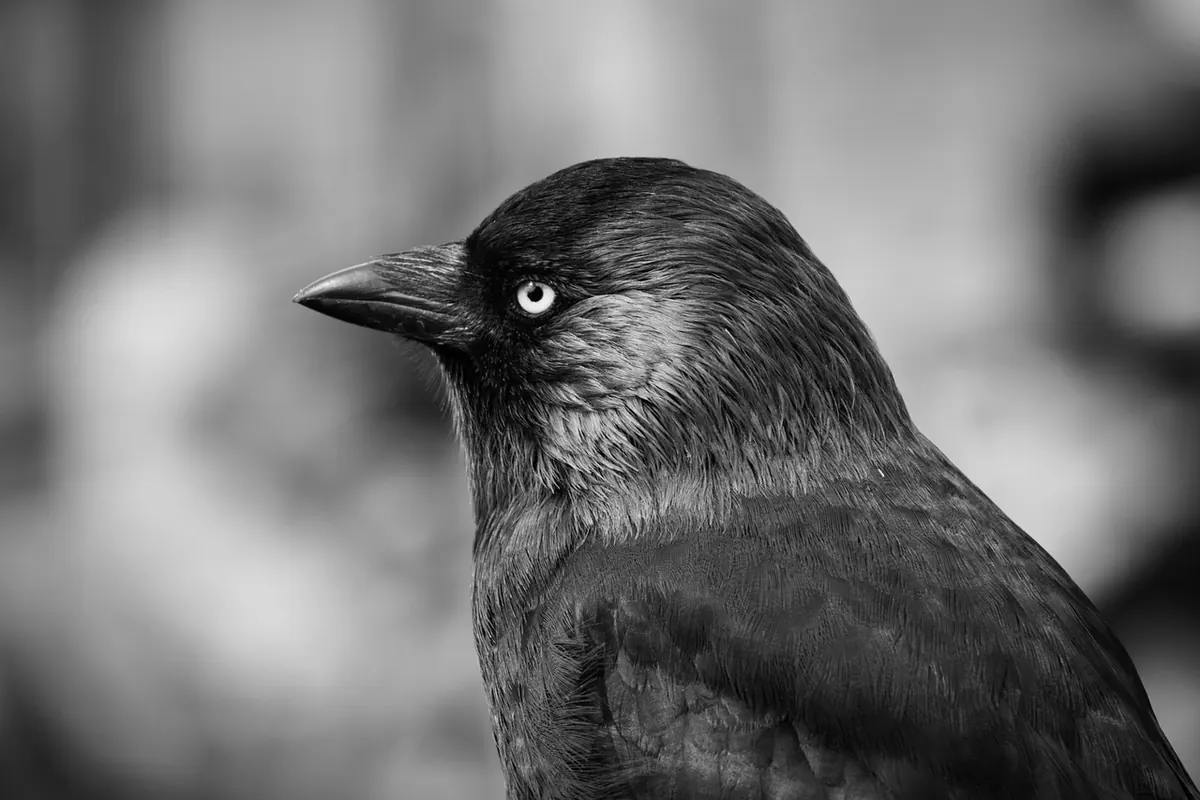
A jackdaw is much smaller — about 33cm, close to a feral pigeon in bulk — and neat with it. Compact body, round head, short stubby bill, no visible trousers, tidy tail. Where a rook looks as though it was assembled from spare parts, a jackdaw looks tailored.
The head is where most answers live
The rook's bare face
Adult rooks have a patch of bare, greyish-white skin at the base of the bill that runs back under the eye and chin. It looks slightly wrinkled, as though the feathers have rubbed away — which, more or less, is what has happened. Nothing else in a British field looks quite like it. Even a bad, backlit view of a rook usually shows that pale face and the long, slightly downcurved bill above it.
The jackdaw's silver hood and pale eye
Jackdaws keep feathers all over the face, but the nape and sides of the neck are a soft silvery grey that stands out against the blacker cap and body. The bill is short and blunt. Adults have a pale, almost white eye that glints in sunlight — a small detail, but a decisive one at 20 metres.
Two exceptions are worth carrying in your head. Juvenile rooks have fully feathered faces and a dark bill base, which makes them look alarmingly like carrion crows: lean on the peaked crown, sloping forehead, pointed bill and baggy trousers instead. Juvenile jackdaws have dark eyes and a less obvious grey hood, but they are still obviously small.
In flight: steady versus frantic
A flying rook rows. The wingbeats are slow, deep and deliberate, and the bird glides or soars regularly, often circling up on a thermal or dropping into a field in a tumbling, rolling descent. Its bill and head project forward, and flocks stream out into loose lines rather than a tight bunch.
A flying jackdaw flicks. The wingbeats are quick and shallow, giving a bouncy, slightly blown-about flight, and it rarely glides for long. In spring, jackdaws perform tumbling display flights — half-rolls and dives — while calling constantly.
A practical test: if you watch a bird for three seconds and it holds a glide for more than a moment, it is almost certainly a rook. Jackdaws keep working the whole time.
Voice: listen before you look
Sound is the fastest separator of all, and both species say their names.
A rook's call is a flat, hard, drawn-out kaaah, repeated on a steady pitch — a sound like a rusty gate that needs oiling. In a rookery, dozens overlap into that familiar cauldron of noise you can hear from a good distance away.
A jackdaw's call is short, clipped and metallic. The classic is a sharp jack or tchak, often doubled, with a tone somewhere between two coins tapped together and a small door clicking shut. Paired birds exchange a softer chyuck, and the alarm is a higher, more urgent kya.
- Sharp, single or doubled jack or tchak — jackdaw.
- Long, flat, grumbling kaaah, repeated — rook.
- A chorus from treetops with staccato notes cutting across it — a rookery with jackdaws mixed in.
Give it a second call before you decide. One note can be misleading; two rarely are.
Colonies, chimneys and how they live
Rooks are colonial to the bone. They build stick nests in the crowns of trees, often in long-established rookeries used for decades, sometimes in the middle of a village or beside a road. They start early — nest-building often begins while the weather is still grim — and outside the breeding season they roost communally and feed in loose flocks out on pasture and stubble, probing the soil with that long bill. A field full of rooks following a plough is one of the sights of a British winter.
Jackdaws are hole nesters. Tree cavities, chimneys, church towers, old buildings, cliff crevices, and nest boxes meant for owls. Pair bonds last for years and the pair stays together right through the winter, feeding and travelling as a duo within a bigger flock. They are the birds on your chimney pot at first light, and the ones bouncing around the car park.
Because jackdaws need holes rather than outer branches, they can nest in the very trees that hold a rookery: rooks in the crowns, jackdaws down the trunk. Seeing one species in a tree does not rule out the other.
When they mix, and the exceptions worth knowing
Mixed flocks are common in winter, especially on grass and stubble, and it pays to scan them rather than pick a bird at random. Look for the small ones with quick, flicking wingbeats and you have the jackdaws. Look for the larger, slower birds that glide between bouts of rowing and you have the rooks. A grey face patch settles it outright. A pale eye and a silver nape settles it the other way.
Photo: HeiKiwi / Pixabay