
7 Common Mistakes When Identifying Rooks (and How to Avoid Them)
Rooks are easy to misread at distance or in poor light. These seven common identification errors, and the field fixes for each, will keep your corvid records accurate.
Nobody learns corvids from a field guide alone. Rooks are the classic casualty: black, sociable, everywhere, and endlessly written off as Carrion Crows or muddled up with Jackdaws. The encouraging part is that almost every mistake comes from the same handful of habits — checking the wrong feature first, or checking it in the wrong conditions. Here are the seven slips that catch out most birdwatchers, with the practical fix for each.
1. Assuming any black crow is a Carrion Crow
The default setting for most of us is "black corvid equals Carrion Crow". It is understandable: crows are territorial, visible and familiar. But it produces two errors at once. Lone Rooks get dismissed as crows, and flocks of Carrion Crows — which do gather at winter roosts and on good feeding sites — get logged as Rooks simply because there are a lot of them. Both species can be solitary, both can be gregarious, and both turn up in the same places in the same months. Stop identifying from habitat and company alone. Treat the bird as unidentified until you have a shape feature, a bare-part feature or a call.
2. Leaning on the bare face patch
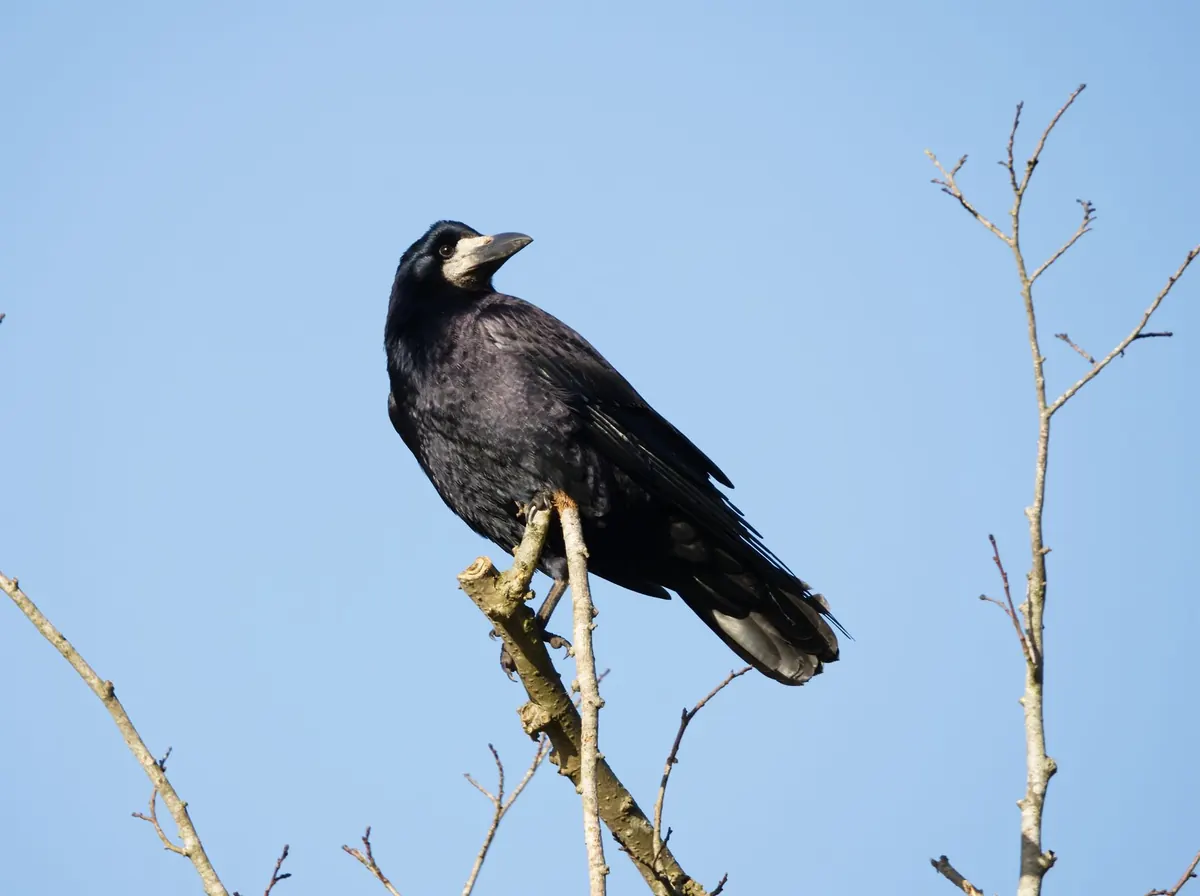
An adult Rook's pale, bare face patch — grey-white skin at the base of the bill, spreading over the face and peppered with bristles — is its most famous feature. It is also the one that fails most often. Juvenile Rooks leave the nest with a fully feathered face, and the bare skin only develops gradually over their first autumn and winter, so a young bird in late summer genuinely has no patch at all. In flat light, a distant adult's patch can read as a muddy smudge rather than clean skin. Use it as confirmation, not as your opening question. Ask about bill, crown, build and voice first; if the patch is there too, you can relax.
3. Relying on size
Rook and Carrion Crow overlap so closely in size that a lone bird in a hedge tells you almost nothing. Size shifts with sex and age, posture inflates it, and distance wrecks the comparison. Judge proportions instead:
- Bill: the Rook's is longer and thinner, with a straighter upper edge meeting the forehead at a steeper angle. The Carrion Crow's is heavier, deeper at the base and more evenly curved.
- Crown: the Rook's head looks peaked and rather flat-topped, giving that classic "Roman nose" profile. The crow's looks domed and rounded.
- Rear end: the Rook's thigh feathers are loose and shaggy, so the back end looks skirty, as though it is wearing baggy trousers. The crow looks neater.
- Legs: Rooks often show more leg below the body when standing on grass or a fence rail.
4. Misreading a silhouette in flight
In the air, corvids become black shapes, and that is where plenty of records go wrong. The useful cues are rhythm and outline, not colour. Rooks tend to fly with quicker, shallower wingbeats on narrower wings, and the slender bill gives the head a pointed look. Carrion Crows beat their wings more deeply and deliberately, and the whole bird reads as broader and blunter. Watch for ten seconds rather than a glance: the tempo is usually more reliable than any single feather tract. Gloss is a trap — in decent light both species shine, and what colour you see depends on angle and feather wear. Check, too, whether the bird is part of a loose, tumbling flock or travelling with purpose.
5. Ignoring what the birds are doing
Behaviour will not identify a single bird on its own, but it stacks the odds. Rooks nest colonially, sometimes in the same stand of trees for decades. They feed in flocks on arable fields, probing the soil, often alongside Jackdaws, and they gather noisily at pre-roost sites. Carrion Crows generally operate as pairs or family parties, hold a territory, and feed in twos and threes. Exceptions are everywhere — crows roost communally in winter, and a lone Rook in a garden is not remarkable. So treat behaviour as a strong hint that sends you back to the shape features, never as the answer by itself.
6. Confusing Rooks with Jackdaws
Jackdaws share the same fields and frequently the same mixed colony, which is exactly why they get mislabelled. They are noticeably smaller, with a short stubby bill, a quick bouncy flight and, on adults, a pale silvery eye that stands out at twenty paces. Their call is a clipped, metallic "tchack"; a Rook's is a long, harsh, raucous "kaah". If every bird in a stubble field looks like a crow with a squashed face, you are almost certainly watching Jackdaws.
7. Trying to do it all by eye
Identifying corvids without listening is like reading half a book. Rooks are loud and talkative, especially around the colony in spring, and you will often hear them before you see them. Learn three sounds: the Rook's drawn-out, harsh "kaah"; the Carrion Crow's harder, flatter "caw"; the Jackdaw's clipped chack. Play recordings through once before you head out, then stand under a rookery in March and match what you hear to what you see. It is the quickest single upgrade to your corvid identification.
A two-minute routine that prevents most mistakes
Next time you meet an unidentified black corvid, work through this in order:
- Name the two birds you are choosing between. Take nothing for granted.
- Get the light side-on rather than behind the bird, and lift your binoculars.
- Check the bill, then the crown, then the shagginess of the rear end. Ignore size.
- If it flies, watch the wingbeat and outline for ten seconds.
- Listen. If it calls, the answer is usually immediate.
- Ask about company and behaviour last, as confirmation.
- If it still does not add up, record it as "corvid sp." and move on. An honest blank beats a wrong dot on the map.
Rooks reward patience more than cleverness. A few sessions spent deliberately studying a rookery, a stubble field and a winter crow roost will do more for your identification than any amount of squinting at a distant bird in the rain. Make notes while the bird is in front of you — what the bill did, how the wings beat, what you heard — and the pattern will start to look after itself.
Photo: Phil Mitchell / Pexels